![]() |
Friday, 26 February 2021
February full moon esbat - rekinding old circles
Monday, 22 February 2021
Thoughts on playfulness and ritual
I remember my school days, when at the end of the school year we would have a service at the local church and our teachers would keep an eye on us and place all the rowdiest pupils in the front rows. Any misbehaviour would be punished. When we went to church with my family it was the same: you had to sit quietly in your seat and pay attention, dress neatly and be at your best behaviour. Going to church was a boring event, yet stressful because of fear of doing something wrong and having everyone stare at you.
When I started getting into Wicca and performing Wiccan rituals, I had to face these past experiences. Even today, when I have been Wiccan for a larger part of my life than I was Christian, I still remember and confront these past experiences: the gravity of going to church, the kneeling at the altar, the submission to a higher power that might judge you for accidentally farting during service. When one comes from this tradition, how does one move on from it?
***
My first rituals were quiet and still. I lived with my parents who did not tolerate deviation from their Christian tradition. They were by no means fundamentalists, in fact they were quite secular. However, they had grown up Christian and knew nothing else. Add to the fact that at this time Finland had just had its share of the satanic panic, so anything deviating from the safety of Christianity and tradition was scary to them.
So I set up small altars that would not draw too much attention, I told them not to disturb me because I wanted to meditate. And so I sat down in my small room, in front of the few ritual objects I owned (a rock, a seashell, a feather, a red candle and some incense) and I performed my rituals sitting there, while visualising myself performing circlecastings, quartercalls, communing with the gods, etc.
My rituals were almost as quiet as my church visits, if not even more so. I had no hymns to sing, not that I could have sung them anyway, and no space to move. When I moved away from home a few years later and got my own apartment, I finally had space to perform rituals and no one to hear me. But breaking out of the quiet shell during ritual was difficult. I had no problem doing so outdoors, but indoors was problematic.
Today I still reflect on this difficulty because it is still present, especially when I do solo rituals. During group work it is easier to speak out loud, to move, but sometimes it feels silly and pointless to do it by myself. At those times I remind myself that I do this for my gods, not for anyone else to see and that usually helps. I have also noticed that the more I do it, the easier it gets. At times in my life when I have had less time to perform ritual, they also tend to be more quiet when I start again.
![]() |
| Rituals can be breath-taking and demand silence, like this early morning view that I woke up to last summer. |
But what about playfulness? What does it have to do with ritual? I will get into how I personally approach playfulness in ritual shortly, but let me first make a few notes about playfulness and ritual in general. As a theologian one of my interests of study has been ritual theory. I also study games, and there is a peculiar overlap between ritual theory and game theory regarding playfulness, or what might otherwise be called a ritual mindset.
To phrase it as concisely as I can: In order to enter a ritual or a game, the participant has to be willing to engage with a ritual mindset, a certain playfulness. This entails a willingness to submit to the rules of the game or ritual, as these are governed by other laws than those of the mundane world. When we enter a game we accept the reality of the game and the rules it entails. At the same time we leave behind our mundane selves and commit to a role in the game. When playing chess it really doesn't mater if you are a lawyer of a nurse in real life. For the sake of the game you are equal players. Likewise, when we enter ritual, eg. the Wiccan circle, our mundane lives, social positions and status give way to our roles as participants in a ritual. Once we exit the ritual or game, our lives return to normal.
In order for this process to work, for us to be able to enter the liminal space of ritual, the world between worlds, we need a certain kind of playfulness. We need to accept that the ritual reality is needed. To achieve this we might use certain symbols to trigger this response: we decorate an altar with special tools, we light candles and incense to set the mood, we wear jewellery specifically dedicated for ritual use. We set the mood, and we set our minds. And through this, we are able to experience ritual in a completely different way than without preparation.
I have sometimes wondered if this preparation is what has made Wiccan rituals so powerful for me? Compared to those church-visits where everything seemed boring and non-engaging, would they have felt different if we had prepared for them? I remember my confirmation: There was preparation, there was the wearing of robes and memorising of verses. I looked forward to it, but I still felt like I was being watched and judged. Maybe I could blame our church leaders? I'm not sure.
![]() |
| Rituals can also function as doorways to other worlds and new perspectives on life, philosophy and other things. |
Ten years ago I got together with some other Wiccan friends. None of us had really performed ritual together with others before, at least not in a group. All of us came from similar backgrounds so we had some quite extensive discussions on ritual and how we wanted it to feel. This was extremely valuable to me, as I learned that it was no big deal if one stumbles a little on the words, or if mead is spilled on oneself while drinking. Or that laughter is a wonderful addition to ritual.
Since then I have tried to keep these things in mind and to not bee too serious in ritual. I mean, of course rituals are serious business, but that does not rule out that they can be fun. In fact, they should be. In the words of Doreen Valiente:
"Let there be reverance and mirth within you."
Those words are from the Charge of the Goddess and they ring true for everyday practice as well as for ritual.
~Stella
PS: A really interesting and fun way that I have found for dealing with my past church-experiences within Wiccan ritual, is to sometimes chant or intonate (in Swedish: mässa) certain parts of ritual. If you haven't tried it you should. It feels super ritualistic and works well. And it can lend a special feel to group rituals.
Sunday, 14 February 2021
Reconstructing some parts of the blog
I am currently working on reconstruction some parts of the blog pages, in particular the Resources section. It has grown beyond it's original scope and needs a proper restructuring. I intend to add a lot more resource links to the blog and expand the literature section, but the current format does not work the way I intended and is hard to navigate. Thus I am am trying to figure out a way to make things more manageable.
Simply adding books on random would be easy, but I like to keep a curated list of books I have actually read or know to be good. Quality before quantity is what I am aiming for in all I do, and I will keep to this as I expand the resource section of the blog.
With that said, I will not take down the pages while I work on restructuring them. Thus they might look a bit chaotic for an unforeseeable future, but they will get into shape soon enough.
While you wait, why not listen to the latest episode of Druidcast, episode 166, where Damh the Bard interviews Einar Selvig of Wardruna?
Friday, 22 January 2021
Sabbats and moons of 2021
At the end of the dying year or the beginning of the new one I usually make a list of the new years full moons and sabbats. In my calendar (on my part this is a bullet journal) I also mark the other phases of the moon. Last year I marked these in an elaborate circle chart. This year gets a much simpler approach with a neat lists.
This year we get 12 full moons and 12 new moons. I think it also looks like many of the full moons fall quite close to the sabbats.
January
Last quarter: 6.1
New moon: 13.1
1st quarter: 20.1
Full moon: 28.1
February
Imbolc: 1.2
Last quarter: 4.2
New moon: 11.2
1st quarter: 19.2
Full moon: 27.2
March
Last quarter: 6.3
New moon: 13.3
Ostara / Spring equinox: 20.3
1st quarter: 21.3
Full moon: 28.3
April
Last quarter: 4.4
New moon: 12.4
1st quarter: 20.4
Full moon: 27.4
Walpurgis nacht: 30.4
May
Beltane: 1.5
Last quarter: 3.5
New moon: 11.5
1st quarter: 19.5
Full moon: 26.5 (lunar eclipse)
June
Last quarter: 2.6
New moon: 10.6
1st quarter: 18.6
Litha / summer solstice: 21.6
Full moon: 24.6
July
Last quarter: 1.7
New moon: 10.7
1st quarter: 17.7
Full moon: 24.7
Last quarter: 31.7
August
Lughnasadh: 1.8
New moon: 8.8
1st quarter: 15.8
Full moon: 22.8
Last quarter: 30.8
September
New moon: 7.9
1st quarter: 13.9
Full moon: 20.9
Autumn equinox: 22.9
Last quarter: 29.9
October
New moon: 6.10
1st quarter: 13.10
Full moon: 20.10
Last quarter: 28.10
Samhain: 31.10
November
New moon: 4.11
1st quarter: 11.11
Full moon: 19.11 (lunar eclipse)
Last quarter: 27.11
December
New moon: 4.12
1st quarter: 11.12
Full moon: 19.12
Yule / Winter solstice: 21.12
Last quarter: 27.12
Tuesday, 1 December 2020
Building community
As the pandemic has spread and affected almost every aspect of our lives during the past year, and as we have struggled to adjust to a life of lockdowns and not being able to meet up with our friends, ritual groups or covens, as events have been cancelled and we have been forced to socially distance and isolate ourselves in order to protect each other, life has become much different this year than expected. And while it certainly has been very challenging at times, even painful, I am once again astounded by how we can build community.
As the pandemic hit Finland I was about a month away from hosting a pagan retreat. First we postponed the event, then we had to cancel it completely. I cannot deny that I cried a little as a lot of hard work and many emotions had been put into this event. However, me and my co-organizer, Fenris, were determined to not give up on the project and we moved parts of the programme online, to a two day zoom-conference. We advertised it among our small Fenno-Swedish community but also in Finnish-speaking groups on FB. We also contacted a coven leader in Sweden about hosting a program item during the seminar.
The result was interesting. Not only did we have a guest from Sweden participating, but we also had other Finnish pagans participate who had not previously attended our moots or participated much in our discussions. As a result of this diverse group meeting, we started hosting moots online. The Helsinki based Finnish moots also moved online during the same time and I decided to start joining them. This turned out to be one of the best decisions I have made in a long while.
From the Finnish moots was born the idea for an international panel discussion after which some countries hosted their own online moots. I decided to join the Swedish moot, just to see what kind of people were around there. This moot, once more, sparked a whole new series of moots, and since may there have been monthly online moots on Zoom that bring together Swedes and Fenno-Swedes on a regular basis. And these are no mere pub moots.
![]() |
| This was my calendar for Samhain 2019 to Samhain 2020. 2021 will see its own version. |
Tonight, on the full moon, we had the seventh moot in the form of a panel discussion about solitary contra open circle contra coven work in Wicca. I participated as one of the panelists, representing a solitary, eclectic side. The discussions were very interesting and thought provoking, but what stuck with me was the sense of community that these moots have created.
And that is why I am writing down these thoughts. Because although the pandemic has had a huge impact on life, especially social life, it has given me the opportunity to form new connections, to network like never before, and to build communities that I would never have though possible. If a year ago you would have said that this spring I would be giving lectures about the Witches' Pyramid of participating in panels about how to practice Wicca in different kinds of group modes, then I would have said you were jesting. But here we are.
I marvel at the possibilities that have arisen from the dire situation that we are in, and it gives me hope and warms my heart to think that although life this year did not turn out as we would have hoped or imagined, we can still find the good things and create and build positive community.
I hate many things about this year, but I love the good things it has brought into my life.
Blessed be!
~Stella
Tuesday, 21 April 2020
Out in the woods
Enjoy!
~Stella
Thursday, 2 April 2020
Forming new routines
I myself have been laid off work (luckily I did not loose that much money because of it since it is a few-hours-a-week job, but it still feels bad) and as schools and universities have closed and transformed all education to distance-learning, my schedule has opened up a surprising lot. Now, I do count this as a blessing, but it has come with its challenges.
![]() |
| Teatime is always at two o'clock! |
I know that I am most productive during the hours after I have just woken up (between six and seven in the morning). So I have now started placing articles and other school material next to my bed so that I may reach for them before getting up (I know, really good sleep hygiene right there, not).
Another thing I have struggled with is eating regularly. I know exactly what happens if I go too long without eating. I usually don't get hungry before it is too late and my blood sugar drops, causing dizziness and grumpiness. So I have started implementing a schedule for eating, mostly focusing on breakfast, lunch and dinner, with snacks in between if necessary. I keep a meal planner on the side of my fridge. It helps me plan my meals and manage what food items need to be consumed before they go bad.
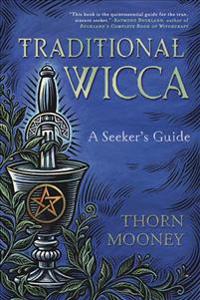
I have also tried to go to bed earlier, at the latest around the time I am now writing this blog. And since there is a lot going on right now with trying to manage the situation and keeping in touch with friends and family, I will also start to implement an even stronger and firmer evening routine. I have thus far tried to read at least on chapter of a book before going to sleep (before penning these thoughts I just finished Thorn Mooney's Traditional Wicca). Now I will try to couple that with meditation before sleep.
New routines form as we adjust to the situations that arise around us. We are humans and we are adaptable, even in the face of a pandemic. We will come out of this at some point, hopefully having learnt some life lessons. And remember: This too shall pass.
Blessed be!
~Stella
Sunday, 22 March 2020
Updates
I have been looking at the blog in dismay for a while, especially the resource section. Thus, I have currently begun the project of reorganizing the blog slightly. Here are the changes that are taking place:
Blog appearance
The blog is changing its appearance. Some changes have already been made but I am working on a new banner among other things.
Pages
All pages have been updated. The Resources-page has seen some major changes and now includes more resources with a completely new structure. I will keep adding to this as time passes. I also take suggestions for things to include.
I am also working toward adding more pages to this blog. This will, however, take some time as I run two blogs on the same topic in different languages. My hope is to be able to cross-post some content while still maintaining the uniqueness of both blogs and allowing them to complement each other.
Special thanks
I want to give a special shout-out to my dear friend Fenris who proofreads my blog and gives me advice on formatting and editing. Fenris is a professional journalist and web manager. You are a true inspiration and your support keeps me writing.
Fenris is also going to make a guest appearance on the blog soon, with a review that he has written.
A big thank you also to everyone who has asked questions and given suggestions for topics I could write about. Some of them will be included here, and others might be answered in Swedish on Häxagram.
Questions and suggestions
For anyone who wants to send me comments, questions or suggestions anonymously, there is now an option to do so through my questions box.
That is all for this time. Thank you for reading.
Blessed be!
~Stella
Saturday, 21 March 2020
Words matter - Chapter 1: Wicca, witchcraft & witch
This is a topic that has been discussed to no end in witchcraft circles, but there still seems to be some confusion about it, and I can see where some of it comes from. The terms Wicca and witchcraft are often used interchangeably, not least in older Wiccan literature.
In this article I will discuss some of these terms. and how they relate to each other. I do not profess to have the Ultimate Answer (TM), however, I will be basing this article off of academic work as well as that of reputable authors from the pagan field (some of which are the same). I would also like to point out that there is some confusion of terminology even among scholars in the area.
Let us begin.
Wicca & witchcraft
The terms Wicca and witchcraft are often confused with each other, especially among people who are familiar with neither concept. When I picked up a book called Wiccapedia a while back, I assumed that the name was a combination of the words Wicca and encyclopedia. Oh dear, how wrong I was. It was not an encyclopedia, and it had very little to do with Wicca, at least not in the way I have come to know it. This book, however, used the terms Wicca and witchcraft interchangeably as if they were the same thing. This is something that happens elsewhere as well, and something that I am also guilty of.So what is the difference then? What differentiated Wicca from witchcraft?
From an academic perspective witchcraft is, simply put, anything today or historically dealing with the practice of magic, anywhere in the world. That is to say: whether you practice folk magic, kitchen witchery of ceremonial magic, you are practicing witchcraft.
![]() |
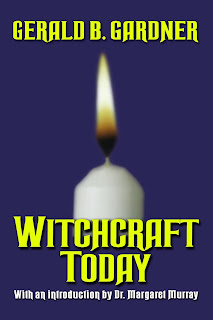
| Gardner's Witchcraft Today, 1954 |
In the earliest works about Wicca, the term Wicca had not yet become widely used. Instead terms like "the old religion", "Witchcraft" or simply "the Craft" were used. Notice the difference in capitalization between Witchcraft and witchcraft. The former refers to a religious practice, and the latter to a general practice.
Wicca was and still is a religion based on witchcraft, and thus, to the early authors of books on the old religion, it would have been only natural. Look up some titles by Gardner and Doreen Valiente (the "mother of Wicca") and you will find the term Witchcraft widely used in them. This is a good thing to keep in mind while reading books by Wiccan authors: the terms used to be, and still sometimes are, used interchangeably.
The term Wicca became popular during the 1960s when the religion started to spread and split into different traditions, and it is now the most widely used name for the religion. A Wiccan is a practitioner of witchcraft, but all practitioners of witchcraft are not necessarily Wiccan.
Let us make a quick summary:
Wicca: a new witchcraft religion created in the mid 20th Century by Gerald Gardner, with roots in the western esoteric tradition, and the assumption of an unbroken continuance from a (since disproven) pre-Christian fertility religion that evolved into the so called witch-cult after Christianity took over. Wicca has evolved and developed a lot since its inception in the 1950s and has become a diverse religion with many traditions.
Witchcraft: the practice of a witch's craft, an umbrella term for different methods and practices.
Witch
What then, is a witch? Let us simply skip the caricature picture of the old wart-nosed hag stirring her cauldron. A witch, simply put, is someone who practices witchcraft. If we look back to the era of the witch-hunts, it was a term applied to both men and women equally, and in witchcraft circles it is considered a gender neutral term, even though popular media seems to want to differentiate between the genders (just look at Netflix's Sabrina-series where witchcraft-practitioners are pushed into different classes because of their assumed gender, into witches and warlocks, who supposedly own different power potentials).Before I go off on an other tangent, let us reiterate that the word witch is gender neutral and anyone practicing witchcraft is a witch. You do not, of course, have to call yourself a witch if you do not want to. Most countries have their own terms for practitioners of witchcraft.
***
Interesting to note is that, in my experience, these terms have become more widely discussed in recent times. Most books before this millennia seem to be more interested in discussing paganism than witchcraft, and that might have something to do with a few things:
![]() |
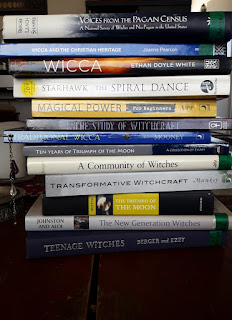
| The research pile just continued growing while writing this article. |
Thirdly, I think that instead of studying witchcraft, academics tend to keep to the topic of occultism. The occult handles esoteric thinking and theory, as well as magic(k), which is also a part of witchcraft. Witchcraft as it's own thing, however, is not being as widely studied, but it seems now to be a burgeoning field attracting new attention from academics.
Paganism, neo-paganism, occultism and western esotericism will have to require their own chapters. Thus I will end this chapter here, hoping you have gleaned some more clarity into these three terms. Questions can be posted below, or in my question box.
Sources
Berger, Helen A. (1999): Witches - Contemporary Neo-Paganism ans Witchcraft in the United StatesJohnston, Hannah E. & Peg Aloi (2007): The New Generation Witches - Teenage Witchcraft in Contemporary Culture
Pearson, Joanne (2007): Wicca and the Christian Heritage - Ritual, Sex and Magic
White, Ethan Doyle (2016): Wicca - History, Belief, and Community in Modern Pagan Witchcraft
Wednesday, 18 March 2020
Ritual of hope and healing
Amidst all the people hoarding food and toilet paper (for which a special place in hell has been reserved if they do it without good reason, especially here in Finland where paper never runs out), and the neighbors who turn their back at you in the stairwell out of fear of infection, what can we as a magickal community do?
In the Finnish Wicca group on Facebook, the following video was posted today. It is a call to action by Chi Nami for the magickal and spiritual community to raise energy to heal, help and create hope in the world during this pandemic. The ritual will take place on Friday 20th March at 8.00 p.m. UTC +2 (= 2 p.m. EDT).
If you are not into doing ritual, you can send a prayer as well. However, if you do want to do a ritual, but do not know how to structure it, here is what I will do, presented as a complete ritual structure.
Ritual of hope and healing
- Elemental representation for Water and Earth: a bowl of salt water
- Elemental representation for Air and Fire: smoldering incense
- Any representations for your deities*
- A white candle. You could also opt for three different candles:
- Light green for healing
- White for helping
- Yellow for hope
- Cakes and ale (aka. some food and drink to help you ground after raising and sending energy)
- Ground and center
- Magickally cleance your space and yourself by asperging (springling salt water) and censing (wafting incense).
- Cast the circle in your preferred manner
- Call the quarters, starting with the East
- Invite Deity* and state the intention of the the ritual
- Meditate for a moment on the goal of this ritual, visualizing it in your mind:
- See before you how healing and help comes to everyone in need, and how hope is born.
- Keep this visualization firmly in your mind as you start raising energy. You could use a number of methods:
- Drumming
- Chanting/singing
- Dancing
- or others
- While you keep the vizualisation going in your mind, as the energy rises and comes to a peak, release it and send it out into the world to do its work.
- If you have any residual energy left you can earth it
- Next, bless the cakes and ale (or whichever food and beverage you have) and relax for a moment. If you invited Deity, share some with them.
- When you feel ready, and it is time to end the ritual, start by thanking Deity for their presence and help.*
- Release the quarters
- Open the circle
Monday, 2 March 2020
Daily Spells: Courage Cord
Day: Tuesday (associated with the planet Mars, and with courage and protection among other things)
Moon phase: Waxing (growing)
Ingredients: A red cord
Your goal is to be more courageous and thus feel more protected. If it helps, you can write your goal on a piece of paper. The idea is to use the power of the growing moon to let your courage grow. As Tuesdays are associated with Mars you can also draw upon these energies. The color red is associated with courage and thus with Mars and Tuesdays, so here we find a triple connection.
This spell uses the classic knot magic. With each knot you tie you are knotting your goal into the cord, making it a physical representation of courage. You can then place it on your altar, bedside table or wear it as a bracelet, wrapped around your wrist.
During the day, ground and center yourself and then create your sacred space. Follow whatever ritual format you normally would do. As you start the spell, pick up the cord and hold it in your hands. Visualize your goal clearly. As you begin tying knots into the cord, feel your goal starting to manifest, your courage starting to grow. Tie the nine knots in the following order (starting with 1 and ending with 9) and recite the verse, always keeping your goal in focus, tying it into the cord:
Monday, 17 February 2020
Compassion, goals and building a practice
Blessed be!
~Stella
Thursday, 13 February 2020
Harmony Nice: Wicca - a modern guide to witchcraft and magic
So that is that, now let's get into the book itself.
What did I like about the book?
- Nice has a very positive tone to her writing. Reading the book made me feel like I was listening to her happily telling me about how happy she is to have found Wicca.
- Although some parts are very floofy and lofty in their description of things, she gives very good practical advice for example on how to celebrate sabbats. There is some very down-to-earth advice to be found in the book.
- Easy to read. This book is very easy to read and it took me only a few hours to do so. There is no difficult language, although at times I felt like it was almost too simplified. But that might be editing.
- The book is beautifully layouted, but that unfortunately adds little to the content. It does look good on Instagram, though.
- Ethics. Nice discusses the Wiccan Rede and ethics in casting spells etc. at some length and returns to these points in other parts of the book.
- A book with the main title Wicca, should be about Wicca. If the second chapter is about divination I will not be able to think it is seriously written. I do however think that this is a symptom of the author's youth and of the fact that divination is a huge part of her own life.
- Nice gets that basics of Wicca right (except for it's history, I'll return to that soon), but mentions belief in deity very briefly. For a book about a religion I feel that it is a huge red flag if deity is mentioned in passing. She does list gods and goddesses of different pantheons, but that has little to do with actual worship, or with the core beliefs of religion.
- Not giving credit where credit is due. Nice cites Lady Gwen Thompson's poem known as the Long Rede while saying that the original author is unknown. A common misconception which is easily rectified through a simple google search.
- The history of Wicca. This point really bugs me. Wicca is a modern religion created in the middle of the 20th Century by Gerald Gardner based off of Margaret Murray's Witch cult-theory which had been definitively debunked by the 1970s. Yet Nice writes that Wicca is centuries old and was "popularized" by Gardner in the 1950s. In the 21st Century we cannot go on propagating this kind of misinformation if we as Wiccans are to be taken seriously. However. This might have something to do with the sources she has read. She cites Scott Cunningham extensively but almost no other authors. Which leads me to the next point.
- Sources. Scott Cunningham is almost her exclusive source. Cunningham's Living Wicca is one of the most popular books written by any Wiccan author still being sold, but it is dated. It is a book that has gotten many a beginner into Wicca, and it still does. But we need newer, better books, more modern ones. That is why I believe so many new, badly written books are surfacing: there is a demand, but the good books drown in the sea of instagram-worthy bestsellers without any substance.
- Vague language such as "it is believed" and "it is thought". For example when talking about the Gardenerian tradition, Nice writes that "there is thought to be a system of hierarchy ...". This is something that could easily be fact-checked. In many instances she writes about certain things as if they were uncertain. I think this speaks mostly of her inexperience and the fact that she might not (my guess) have read that many books on Wicca yet. But we are all there at the beginning. As we grow and learn we learn more things. And most of us are happy learning the bare basics and that is fine too. However, if you pass your uncertain knowledge on as fact, do not be surprised if someone corrects you. Especially for solitary practitioners of Wicca, gaining quality knowledge about their religion can be a very demanding process (this is also why we need good books about the subject).
From what I have understood from her own comments she was approached by the publishers about writing a book about Wicca and received a fairly short time frame for doing so. This might explain some of the issues I have with the book. However, I think that any serious publisher would fact check the books they are publishing (unless of course they are looking to make a lot of money quickly, which I fear might be the case here).
Harmony Nice has been a Wiccan for a few years as she wrote this book. The lack of experience shows. I believe however that this is a place where she can grow, and that she can produce quality content once she gains more experience in the Craft.
I read this book mostly as Nice's own story about her personal journey into Wicca, but as it is made out as an instructional book about the religion this does create some problems. For example, writing about Wicca and having divination so soon in the book makes it look like divination is an integral part of Wicca. Yes, some, maybe even most Wiccans, use divination, but it is not an integral part of being a Wiccan. And divination is not exclusively Wiccan, but a tool used in many traditions.
Do I recommend it?
I think it is a book that could get many newcomers interested in Wicca. Like Silver RavenWolf's Teen Witch drew me into Wicca as a teen, I believe this book might function as a starting point for so called "baby witches" (by the Goddess do I hate that term).
I hope that if future editions to this book are made, some facts might be corrected and more sources added, or at least a list of recommended reading. In fact, I do hope that in a few years we might see a new, more informed, book by Harmony Nice.
For advanced readers this book has almost nothing to give, but for the person interested in learning about Wicca, and who follows Harmony Nice, I might even recommend this, especially if you can get it from a library or second hand. However, there are better books out there, and Teen Witch is still, despite RavenWolf's many faults as an author, a much better book than this.
~Stella
Thursday, 30 January 2020
Imbolc
As Imbolc is a time for lighter, longer days, and new beginnings after the darkness of winter I am incorporating this into my celebration. I will be going on a small trip on February Eve, so my celebrations at home will take place both before, during, and after.
- I am doing a spring cleaning of the house, or the first part of it. I usually have my large spring clean around Ostara when spring really settles in here, but around Imbolc is a nice time to clean the house and clear the air by cleansing energies. This I will do before the trip.
- During my trip I will be celebrating with a person close to me, the newfound relationship and the hopes we have for the future.
- Once I get home from my trip I will have time to set a new altar for Imbolc-time, light candles and celebrate in ritual.
- I will plant the first seeds of the year. I have some flowers I want to grow this year, so I really hope I can manage to get them to grow so that I may plant them outside in summer.
Friday, 24 January 2020
Updates: Cirkelgemenskap, etc.
Are you Wiccan, a witch, Pagan or otherwise interested in these things? If you speak Swedish there is now an event just for you happening in Finland: Cirkelgemenskap Ostara 2020. You can visit the homepage for the retreat here.
Cirkelgemenskap is a retreat for Swedish-speaking witches, pagans and other like-minded individuals. It will take place in Oravais in Ostrobothnia on 10-12.4.2020, and the sign-up starts on Imbolc. Some material for the retreat will be made available on this blog in English afterward.
So that is that for the retreat. Here are some other updates:
- I will attempt to post a bit more regularly on the blog. As the moon waxes and vanes, so too does inspiration, and energy. Permitting that both inspiration and energy coincide, I will most definitely post more content.
- I have a good friend, a chaos mage, who will be writing a review for the blog on something he has tried out.
- As Ostara approaches, stand by for a post about making witches' hats.
Thursday, 12 December 2019
Save the Date 10-12.4.2020
Monday, 11 November 2019
Tutorial: Utensil pouch
Anyway, today I finished a UFO (or unfinished object) that has been on my table for over a year. I went on a road trip in the summer of 2018 with my best friends, and at a store I picked up the cutest quilting cotton ever: kittens among sewing and knitting supplies. Even though I had placed a ban on myself from buying fabric, I simply could not resist this one. To top it off, I already knew what I would use it for: a pouch for eating utensils.
![]() |
| Is not that the cutest thing ever? |
However I was for some reason unhappy with the pouch I made, ripped out some stitches and then never had the energy to finish it. So it ended up as a UFO in a forgotten corner of my sewing nook. As it resurfaced a while ago it has been nagging me, so earlier today I finished it. And oh the joy. Now I actually have somewhere to put my eating utensils when I go places.
This project was inspired by a video from Shelbizleee, however, I do not remember which one. Shelbizleee creates videos about sustainable living, and if you are interested, the link to her channel is here: https://www.youtube.com/user/Shelbizleee/featured
![]() |
| All rolled up and pretty. |
The following is an attempt at writing a tutorial for sewing a pouch to carry your eating utensils with you. It could of course also function for pens. Post questions in the comments if anything is unclear.
Utensil pouch
- 60 x 17 cm piece of your chosen fabric, plus the same of lining and interlining (I used a thin batting for interlining to give some stiffness to the pouch without making it too rigid, a sturdier fabric could also work)
- ~1 m edge tape or bias binding for binding the edges
- ~0,6 m ribbon
![]() |
| On the right I have marked the fold lines, and the dotted line indicates where to fold the edge to. The dashed borderlines here are the edge tape. |
- Start by cutting your fabric, lining and interlining to the same size (60 x 17 cm). Make a sandwich of these with the interlining in the middle. Use pins of clips to hold them in place
- Sew on bias binding or edge tape to cover the short ends.
- At one end, fold the fabric over 7 cm from the edge, to create a 7 cm deep pocket there. Attach at the sides.
- At the other end, fold the fabric over 10 cm from the edge, creating a slightly bigger pocket. Attach at the sides.
- In the bigger pocket, mark vertical lines and sew these. I made 4 pockets, but you could opt for making 5 instead.
- Now cover the raw, long edges with bias binding or edge tape.
- Put some utensils in the pockets and fold the pouch and roll it up, try to figure out where you want to place the ribbon on the outside. Once you find a point, attach it there and you are done. I decorated mine with a small bow from the same ribbon.
Monday, 14 October 2019
Ritual design and outlay
- Cleansing and consecrations
- Grounding and centering
- Ringing the bell
- Casting the Circle
- Calling the Quarters
- Inviting Deity
- Statement of purpose
- Meditation/Prayer/etc.
- Magical Workings...
- Energy raising
- Cakes and Ale
- Thanking Deity
- Closing the Quarters
- Opening the Circle
- Amber K. & Azrael Arynn K (2006): Ritualcraft - Creating Rites for Transformation & Celebration
- Deborah Lipp (2003): The Elements of Ritual - Air, Fire, Water & Earth in the Wiccan Circle