Showing posts with label Wicca. Show all posts

Tuesday, 1 December 2020

Building community

As the pandemic has spread and affected almost every aspect of our lives during the past year, and as we have struggled to adjust to a life of lockdowns and not being able to meet up with our friends, ritual groups or covens, as events have been cancelled and we have been forced to socially distance and isolate ourselves in order to protect each other, life has become much different this year than expected. And while it certainly has been very challenging at times, even painful, I am once again astounded by how we can build community.

As the pandemic hit Finland I was about a month away from hosting a pagan retreat. First we postponed the event, then we had to cancel it completely. I cannot deny that I cried a little as a lot of hard work and many emotions had been put into this event. However, me and my co-organizer, Fenris, were determined to not give up on the project and we moved parts of the programme online, to a two day zoom-conference. We advertised it among our small Fenno-Swedish community but also in Finnish-speaking groups on FB. We also contacted a coven leader in Sweden about hosting a program item during the seminar. 

The result was interesting. Not only did we have a guest from Sweden participating, but we also had other Finnish pagans participate who had not previously attended our moots or participated much in our discussions. As a result of this diverse group meeting, we started hosting moots online. The Helsinki based Finnish moots also moved online during the same time and I decided to start joining them. This turned out to be one of the best decisions I have made in a long while.

From the Finnish moots was born the idea for an international panel discussion after which some countries hosted their own online moots. I decided to join the Swedish moot, just to see what kind of people were around there. This moot, once more, sparked a whole new series of moots, and since may there have been monthly online moots on Zoom that bring together Swedes and Fenno-Swedes on a regular basis. And these are no mere pub moots.

This was my calendar for Samhain 2019 to Samhain 2020. 
2021 will see its own version.

Tonight, on the full moon, we had the seventh moot in the form of a panel discussion about solitary contra open circle contra coven work in Wicca. I participated as one of the panelists, representing a solitary, eclectic side. The discussions were very interesting and thought provoking, but what stuck with me was the sense of community that these moots have created.

And that is why I am writing down these thoughts. Because although the pandemic has had a huge impact on life, especially social life, it has given me the opportunity to form new connections, to network like never before, and to build communities that I would never have though possible. If a year ago you would have said that this spring I would be giving lectures about the Witches' Pyramid of participating in panels about how to practice Wicca in different kinds of group modes, then I would have said you were jesting. But here we are.

I marvel at the possibilities that have arisen from the dire situation that we are in, and it gives me hope and warms my heart to think that although life this year did not turn out as we would have hoped or imagined, we can still find the good things and create and build positive community.

I hate many things about this year, but I love the good things it has brought into my life.


Blessed be!

~Stella

Saturday, 21 March 2020

Words matter - Chapter 1: Wicca, witchcraft & witch

Wicca and witchcraft, are they the same? Is a witch always a Wiccan? And are all witches Pagan?

This is a topic that has been discussed to no end in witchcraft circles, but there still seems to be some confusion about it, and I can see where some of it comes from. The terms Wicca and witchcraft are often used interchangeably, not least in older Wiccan literature.

In this article I will discuss some of these terms. and how they relate to each other. I do not profess to have the Ultimate Answer (TM), however, I will be basing this article off of academic work as well as that of reputable authors from the pagan field (some of which are the same). I would also like to point out that there is some confusion of terminology even among scholars in the area.

Let us begin.

Wicca & witchcraft

The terms Wicca and witchcraft are often confused with each other, especially among people who are familiar with neither concept. When I picked up a book called Wiccapedia a while back, I assumed that the name was a combination of the words Wicca and encyclopedia. Oh dear, how wrong I was. It was not an encyclopedia, and it had very little to do with Wicca, at least not in the way I have come to know it. This book, however, used the terms Wicca and witchcraft interchangeably as if they were the same thing. This is something that happens elsewhere as well, and something that I am also guilty of.

So what is the difference then? What differentiated Wicca from witchcraft?

From an academic perspective witchcraft is, simply put, anything today or historically dealing with the practice of magic, anywhere in the world. That is to say: whether you practice folk magic, kitchen witchery of ceremonial magic, you are practicing witchcraft.

Gardner's Witchcraft Today, 1954
Wicca, on the other hand, is a religion. It was created in the 1950s by Gerald Gardner who drew a lot of inspiration from the western esoteric tradition and from Margaret Murray's writings about the Witch-cult of Europe. In short Murray picked up on theories that the witches burnt during the witch-hunts were the de-facto descendants of a pre-Christian pagan witch-cult that had lived on in secret. Gardner, who founded his new religion after being initiated into a witch-coven in the late 1930s, believed that this coven was in fact a remnant of the "old religion". But I will leave the history lesson for an other post.

In the earliest works about Wicca, the term Wicca had not yet become widely used. Instead terms like "the old religion", "Witchcraft" or simply "the Craft" were used. Notice the difference in capitalization between Witchcraft and witchcraft. The former refers to a religious practice, and the latter to a general practice.

Wicca was and still is a religion based on witchcraft, and thus, to the early authors of books on the old religion, it would have been only natural. Look up some titles by Gardner and Doreen Valiente (the "mother of Wicca") and you will find the term Witchcraft widely used in them. This is a good thing to keep in mind while reading books by Wiccan authors: the terms used to be, and still sometimes are, used interchangeably.

The term Wicca became popular during the 1960s when the religion started to spread and split into different traditions, and it is now the most widely used name for the religion. A Wiccan is a practitioner of witchcraft, but all practitioners of witchcraft are not necessarily Wiccan.

Let us make a quick summary:

Wicca: a new witchcraft religion created in the mid 20th Century by Gerald Gardner, with roots in the western esoteric tradition, and the assumption of an unbroken continuance from a (since disproven) pre-Christian fertility religion that evolved into the so called witch-cult after Christianity took over. Wicca has evolved and developed a lot since its inception in the 1950s and has become a diverse religion with many traditions.

Witchcraft: the practice of a witch's craft, an umbrella term for different methods and practices.


Witch

What then, is a witch? Let us simply skip the caricature picture of the old wart-nosed hag stirring her cauldron. A witch, simply put, is someone who practices witchcraft. If we look back to the era of the witch-hunts, it was a term applied to both men and women equally, and in witchcraft circles it is considered a gender neutral term, even though popular media seems to want to differentiate between the genders (just look at Netflix's Sabrina-series where witchcraft-practitioners are pushed into different classes because of their assumed gender, into witches and warlocks, who supposedly own different power potentials).

Before I go off on an other tangent, let us reiterate that the word witch is gender neutral and anyone practicing witchcraft is a witch. You do not, of course, have to call yourself a witch if you do not want to. Most countries have their own terms for practitioners of witchcraft.

***

Interesting to note is that, in my experience, these terms have become more widely discussed in recent times. Most books before this millennia seem to be more interested in discussing paganism than witchcraft, and that might have something to do with a few things:

The research pile just continued growing
while writing this article.
First of all, paganism has been more widely studied in the academic field than witchcraft has. Second, since witchcraft practices have become popularized through the rise and popularity of Wicca, druidism and the goddess-worship movement during the latter part of the 20th Century, and the terms Wicca and Witchcraft were, and still are, used interchangeably, there is more confusion about these terms.

Thirdly, I think that instead of studying witchcraft, academics tend to keep to the topic of occultism. The occult handles esoteric thinking and theory, as well as magic(k), which is also a part of witchcraft. Witchcraft as it's own thing, however, is not being as widely studied, but it seems now to be a burgeoning field attracting new attention from academics.

Paganism, neo-paganism, occultism and western esotericism will have to require their own chapters. Thus I will end this chapter here, hoping you have gleaned some more clarity into these three terms. Questions can be posted below, or in my question box.


Sources

Berger, Helen A. (1999): Witches - Contemporary Neo-Paganism ans Witchcraft in the United States
Johnston, Hannah E. & Peg Aloi (2007): The New Generation Witches - Teenage Witchcraft in Contemporary Culture
Pearson, Joanne (2007): Wicca and the Christian Heritage - Ritual, Sex and Magic
White, Ethan Doyle (2016): Wicca - History, Belief, and Community in Modern Pagan Witchcraft

Monday, 17 February 2020

Compassion, goals and building a practice

These are some short thought on how we, when we set new goals for ourselves in our lives (think new years promises and "I'm gonna change my life for the better"), sometimes feel like we end up failing. So read on if you wish.

***

We often set ourselves up for failure by wanting to do too much at a time. We feel like our lives are a drag and so we decide to start meditating daily, doing our devotions daily, pray, go to the gym X times per week, eat healthy, sleep enough, write in our Book of Shadows, or a myriad of other things at the same time. We want change and we want it now.

In September I set a goal for myself to read one book each month. By December I felt as though I had failed. But I did not have a routine in reading. Since then reading has become a little easier because even though I have not realized it, I have been getting a routine. But it has built slowly, little, by little.

Those can all be good goals, but if we lack a previous routine doing them, we are setting ourselves up for failure very effectively, because good and healthy habits take time and dedication to build. It can be your end goal to live like this list you have set up, and if that is so, then good. But start small, with one thing, and slowly change your routine to incorporate this and the other things into your life. And as your life changes, adjust your new routines to suit it. Your goals might even change, and that is okay.

As with learning sports, knitting, playing the piano, or developing any other skill set, we need to give ourselves time and be persistent in learning and getting used to, eg. meditation or going to the gym. We need to allow ourselves to not always succeed, and to recognize that sometimes we simply do not have the time and energy. But if we persistently try we can build new habits to replace the ones we do not like. With time and patience. 


Sometimes it feels like we are getting nowhere with our goals. But as easy it would be to just give up as we feel the path takes us nowhere, it might be good to know that even the smallest steps take us closer to reaching our goal.
Pic from Salamajärvi National Park, Finland, August 2018


The same goes for building your daily Wiccan or magical practice. Above all: Remember to be compassionate with yourself. Be kind and do not demand too much at once. Sometimes life is hard and takes time, and then you just need to be even kinder to yourself at those times.

Love and compassion, not just for others, but for yourself as well. 

Blessed be!
~Stella

Thursday, 13 February 2020

Harmony Nice: Wicca - a modern guide to witchcraft and magic

It is time for an other book review. This time I will be taking a look at Harmony Nice's book from 2018 by the title of Wicca - a modern guide to witchcraft and magic. Harmony Nice is an influencer, a youtuber, who makes videos about fashion and Wicca. She is also active on other social media, such as Instagram. She wrote this book after being asked to do so by a publisher Orion Springs (which is not an occult or pagan publisher).

So that is that, now let's get into the book itself.


What did I like about the book?

  • Nice has a very positive tone to her writing. Reading the book made me feel like I was listening to her happily telling me about how happy she is to have found Wicca. 
  • Although some parts are very floofy and lofty in their description of things, she gives very good practical advice for example on how to celebrate sabbats. There is some very down-to-earth advice to be found in the book.
  • Easy to read. This book is very easy to read and it took me only a few hours to do so. There is no difficult language, although at times I felt like it was almost too simplified. But that might be editing.
  • The book is beautifully layouted, but that unfortunately adds little to the content. It does look good on Instagram, though.
  • Ethics. Nice discusses the Wiccan Rede and ethics in casting spells etc. at some length and returns to these points in other parts of the book. 


What problems do I find with the book?

First off, what is going on in this book in regards to editing? There is no clear structure, and the chapters seem almost at times to be randomly placed in the book. For example, there are two chapters on the moon in completely different parts of the book... I am not certain, but I am willing to think that this might be the fault of editing less so than of the author. But I have never published a book (yet) so I cannot say for sure.

The content is however where I find most issue. Let me summarize:
  • A book with the main title Wicca, should be about Wicca. If the second chapter is about divination I will not be able to think it is seriously written. I do however think that this is a symptom of the author's youth and of the fact that divination is a huge part of her own life.
  • Nice gets that basics of Wicca right (except for it's history, I'll return to that soon), but mentions belief in deity very briefly. For a book about a religion I feel that it is a huge red flag if deity is mentioned in passing. She does list gods and goddesses of different pantheons, but that has little to do with actual worship, or with the core beliefs of religion.
  • Not giving credit where credit is due. Nice cites Lady Gwen Thompson's poem known as the Long Rede while saying that the original author is unknown. A common misconception which is easily rectified through a simple google search.
  • The history of Wicca. This point really bugs me. Wicca is a modern religion created in the middle of the 20th Century by Gerald Gardner based off of Margaret Murray's Witch cult-theory which had been definitively debunked by the 1970s. Yet Nice writes that Wicca is centuries old and was "popularized" by Gardner in the 1950s. In the 21st Century we cannot go on propagating this kind of misinformation if we as Wiccans are to be taken seriously. However. This might have something to do with the sources she has read. She cites Scott Cunningham extensively but almost no other authors. Which leads me to the next point.
  • Sources. Scott Cunningham is almost her exclusive source. Cunningham's Living Wicca is one of the most popular books written by any Wiccan author still being sold, but it is dated. It is a book that has gotten many a beginner into Wicca, and it still does. But we need newer, better books, more modern ones. That is why I believe so many new, badly written books are surfacing: there is a demand, but the good books drown in the sea of instagram-worthy bestsellers without any substance. 
  • Vague language such as "it is believed" and "it is thought". For example when talking about the Gardenerian tradition, Nice writes that "there is thought to be a system of hierarchy ...". This is something that could easily be fact-checked. In many instances she writes about certain things as if they were uncertain. I think this speaks mostly of her inexperience and the fact that she might not (my guess) have read that many books on Wicca yet. But we are all there at the beginning. As we grow and learn we learn more things. And most of us are happy learning the bare basics and that is fine too. However, if you pass your uncertain knowledge on as fact, do not be surprised if someone corrects you. Especially for solitary practitioners of Wicca, gaining quality knowledge about their religion can be a very demanding process (this is also why we need good books about the subject).


From what I have understood from her own comments she was approached by the publishers about writing a book about Wicca and received a fairly short time frame for doing so. This might explain some of the issues I have with the book. However, I think that any serious publisher would fact check the books they are publishing (unless of course they are looking to make a lot of money quickly, which I fear might be the case here).

Harmony Nice has been a Wiccan for a few years as she wrote this book. The lack of experience shows. I believe however that this is a place where she can grow, and that she can produce quality content once she gains more experience in the Craft.

I read this book mostly as Nice's own story about her personal journey into Wicca, but as it is made out as an instructional book about the religion this does create some problems. For example, writing about Wicca and having divination so soon in the book makes it look like divination is an integral part of Wicca. Yes, some, maybe even most Wiccans, use divination, but it is not an integral part of being a Wiccan. And divination is not exclusively Wiccan, but a tool used in many traditions.


Do I recommend it?
I think it is a book that could get many newcomers interested in Wicca. Like Silver RavenWolf's Teen Witch drew me into Wicca as a teen, I believe this book might function as a starting point for so called "baby witches" (by the Goddess do I hate that term).

I hope that if future editions to this book are made, some facts might be corrected and more sources added, or at least a list of recommended reading. In fact, I do hope that in a few years we might see a new, more informed, book by Harmony Nice.

For advanced readers this book has almost nothing to give, but for the person interested in learning about Wicca, and who follows Harmony Nice, I might even recommend this, especially if you can get it from a library or second hand. However, there are better books out there, and Teen Witch is still, despite RavenWolf's many faults as an author, a much better book than this.

~Stella

Thursday, 12 December 2019

Save the Date 10-12.4.2020

Here comes some information in Swedish (see English below):
***

Lystring, du hedning, häxa, andlig sökare eller motsvarande, för nu är det dags för den andra inkarnationen av Cirkelgemenskap!


Markera in 10-12.4.2020 i din kalender, då det blir hednisk retreat i Österbotten.
Är du intresserad av häxkonster men vet inte riktigt var du ska börja?
Vill du gå tillbaka till grunderna och hitta magin i ditt liv?
Tilltalar meditation, energiarbete och musik dig?
Då är det här evenemanget för dig.

Vi finslipar ännu programmet och om du således har förslag får du mer än gärna ta kontakt.

Mera information kommer den 10 januari, då vi publicerar vår hemsida och ett Facebookevenemang. Anmälningen till Cirkelgemenskap Ostara 2020 öppnar i februari.
Antalet platser är begränsade så det lönar sig att vara ute i god tid. 

Arrangörer: Stella och Fenris, genom nätverket Svenskfinlands Wiccavänner på Facebook.
E-post: cirkelgemenskap@gmail.com


****

Short version in English:

The second incarnation of Cirkelgemenskap will take place on 10-12.4.2020 in Ostrabothnia. This is a Swedish retreat for Wiccans and Pagans of all kinds. The focus of this retreat is "back to basics", focusing on magic, energywork, meditation and music. More information will be published in January.

Cirkelgemenskap Ostara 2020 is produced by Stella and Fenris of Svenskfinlands Wiccavänner, a Fenno-Swedish pagan network on FB.

Monday, 14 October 2019

Ritual design and outlay


Well met! This post is about ritual and what my ritual outlay looks like, as well as some advice on how to tweak and redesign your own rituals.

DISCLAIMER:
These are entirely my own methods for creating and doing ritual, based on how I have been taught and how I have been developing it myself, and others may do it differently from me. This ritual outlay is written with a Wiccan perspective, but may also work for others. Use it and tweak it at your own pleasure.

~•*•~

I have done many rituals through the years and I vary the way I do ritual based on the phase of the moon, for sabbats and for special occasions. Sometimes I do them in a very simple and minimalistic way, at other times in full blown ceremonial fashion.
Despite the tools, ritual garb, altar decoration and wordings changing, I have found that some things remain constant. The basic layout or design of my rituals follow a scheme that has not changed much over the years. Here is one I did yesterday at the full moon, in an attempt to recreate some of my earliest rituals:
  1. Cleansing and consecrations
  2. Grounding and centering
  3. Ringing the bell
  4. Casting the Circle
  5. Calling the Quarters
  6. Inviting Deity
  7. Statement of purpose
  8. Meditation/Prayer/etc.
  9. Magical Workings...
  10. Energy raising
  11. Cakes and Ale
  12. Thanking Deity
  13. Closing the Quarters
  14. Opening the Circle

That is the basic outline. I usually divide rituals into sections. Especially when working with groups it is easier to plan them if one can look at a ritual in sections. These are (with examples of content):

Before ritual
Cleansings and consecrations, baths, setting up the space

Beginning the ritual
Circle casting, quarter calls, invitations to deity, statement of ritual purpose

Ritual main part
Magic workings, worship, prayer, meditation, raising energy, cakes and ale, etc.

Ending the ritual
Thanking deity, releasing the quarters and opening the circle

After ritual
discussions, food, cleaning up

These sections are always a part of my rituals in one way or an other. What happens within them and how exactly this is formatted varies. The above picture is one way to do it, but not the only way. Rituals I do using this format may be as short as 15 minutes, up to hours.

I have made it a point in my practice to question why I do certain things a certain way. It is good to make rituals a habit. After a while you learn the flow of the ritual and remember it by heart. But it is also good to be critical of the way you do ritual, as in asking yourself why some things come in a certain order (like cakes and ale), or if there are any other methods for raising energy than the ones you are using.

Usually I only change the order of things within the main part of the ritual, but there are other things as well to consider: How do you cast the circle? How do you call the quarters? Etc. You can vary these methods and learn a lot from them.

Try things out, experiment, and do not fear new methods. Who knows, you might find something that works really well for you.

Here are two books that I warmly recommend for anyone interested in getting more in depth with ritual work:

  • Amber K. & Azrael Arynn K (2006): Ritualcraft - Creating Rites for Transformation & Celebration
  • Deborah Lipp (2003): The Elements of Ritual - Air, Fire, Water & Earth in the Wiccan Circle


I would be happy to hear your thoughts in the comments. I am thinking about writing a short series of posts about ritual work so let me know if this interests you. This series would be theoretical as well as practical.

Blessed be!
~Stella


Sunday, 6 October 2019

Practising your path in your mind

This post is meant as encouragement for the beginner practitioner of Wicca of any Pagan path, and for the one broomcloset witch who cannot practice the Craft openly.

I recently joined the Pagans and Witches Amino, and while browsing posts there I see some posts asking for help with practicing the Craft while living at home with parents that do not necessarily approve. So I wrote this piece.

~***~

I myself grew up in a Christian family, and although I would count them as almost secular compared to some others, they still had hard principles which led them to denounce my choice of Wicca. While still living under their roof, for four years I practiced the Craft as best I could, in secret under their noses.

I thought I would share what I learned during that time, and hopefully it will help you. It helped me to get back to my own practice after some turbulence in my life.


Do what you can, find alternatives

Are you allowed to have candles in the room? Are you allowed to burn incense? Is there a spot you can go to where you can practice undisturbed?

I was allowed candles (but no more than a maximum of two at a time), and incense (but in low moderation). I had a small bedside table where I would light a candle and incense and I would sit quietly in front of this. To my parents I said I was meditating. It worked for me and it might work for you. We all need some quiet in our lives sometimes. This was my way of performing ritual. I will discuss how below.

If you cannot practice at home in privacy, is there somewhere you could safely go where you know you will not be disturbed? I had a spot in a woodland park, slightly off-trail, where I would sometimes go, while sneaking candles, incense, bells and crystals with me in my pockets. I usually went for walks there, so staying a bit longer for ritual or spellwork did not matter.

What of tools then? You might not be allowed an athame, tarot cards or cauldrons, and random bells and wands might look suspicious to some parents. If you stay on this path, you will eventually get all of these. But in the meanwhile, find alternatives.

The athame is used to direct energy, the same goes for the wand. But you can just as well use your finger instead. Any tool you direct energy with is just an extension of yourself and your will.

If you need to find representations for the elements to symbolize them, find something that corresponds with them, that feels like them. For the longest time I used a rock or pinecone to represent earth, a feather to represent air, a red jasper for fire, and a seashell for water.

There are countless things you might use to represent the elements, and if your are crafty you could even make them yourself. Finding different things to use as elemental representations is a good exercise for your mind as well. Which leads me on to the next thing.


The power of the mind
When it comes to performing magic and spells, your most powerful tool is your mind. Magic is to create change in conformity with will, ie. it becomes so because I will it to be so.

As I mentioned earlier, when I started out I would sit in my room, maybe with a candle and some incense, and "meditate". What I actually did was practice ritual and spells. This is possible because of the power of the mind.

The tools we use and the words we say carry symbology that triggers our psyche. This helps our minds support the frameworks of ritual and spellcasting. Or put differently: Tools (as symbols) help us concentrate on the work we are doing.

In itself, the tool does not have any power, besides the one our mind gives it (attunement). This means that even if you had an athame, if you do not know the symbolism behind it, and feel no connection to it, then it will not work for you as a tool because it does not trigger your mind.

In your mind, you can have all the tools you want, or none, that is up to you. When doing ritual or spellwork in your mind, you use visualization to see and feel what you do. You might use physical gestures, but I would usually sit still with my eyes closed. I would even be silent, just saying any words in my mind alone.


Vizualization - the key to successful ritual
I've talked about theory, now let's get down to actually doing it.
If you go in for performing ritual or spellwork in your mind, find somewhere quiet where you can sit, stand or lie down undisturbed. Close your eyes. Imagine yourself in your ritual space. Now you will use your imagination to visualize yourself doing that spell or ritual, following any instructions you have. This will be easiest if you have them memorized.

If you are casting a circle, you can visualize yourself walking around, casting the circle, or you might choose to visualize how the circle just starts forming around you into that perfect bubble. Visualize the tools that you need on your altar, how you prepare spell ingredients and how the spell comes together.

As you raise energy, feel it with your body. You might want to tighten all the muscles in your body as much as possible, and hold on until you are ready to release the energy. When you do, relax your muscles and let go of the energy, but keep the visualization of your ritual or spell going.

End the ritual and take down the circle just as you started it. Then allow your mind to come back to the physical space you are in and reconnect with this world.


"But it's too difficult"
Imagination is something all of us do. As children we are experts on it: imagining we are adventurers, or princesses, or Batman, etc. As we grow older and learn more we tend to use fantasy in imagination less and less, it is a skill we loose.

Visualizing whole rituals can feel very difficult at first because you have to concentrate very hard and keep that concentration going. With practice, however, you will become good at visualizing. And if your first years of practicing magic or Wicca or any other path consists of doing it through visualization, you will become very good at performing powerful ritual and spells later on.

Because, you might light candles, wave your wand, put together spell ingredients, and read incantations, but nothing will come of it if you do not also put the power of your mind behind it. So practice with patience. Maybe just practice casting a circle in your mind at first, or visualize yourself in your ritual space. It can be the room you are in, or a completely different room. Your choice.

However you practice, you will become good at it after a while. When I had done this for a few years, I was able to do it whenever I needed it, wherever I was: on the bus, in class, even once at dinner.

~***~

So let nothing stop you, just start practicing ritual and spellwork, in your mind. Take baby steps while starting and, as Scott Cunningham put it in Living Wicca: Just do it!


Blessed Be!
~Stella

PS: this post has no images, you'll just have to visualize the pictures of all the tools, and of me standing in line for school lunch, eyes closed, doing ritual. ;)

Wednesday, 4 September 2019

Book of Shadows - the Project

Maiden, Mother, Crone. Drawings from my page on the Triple Goddess.

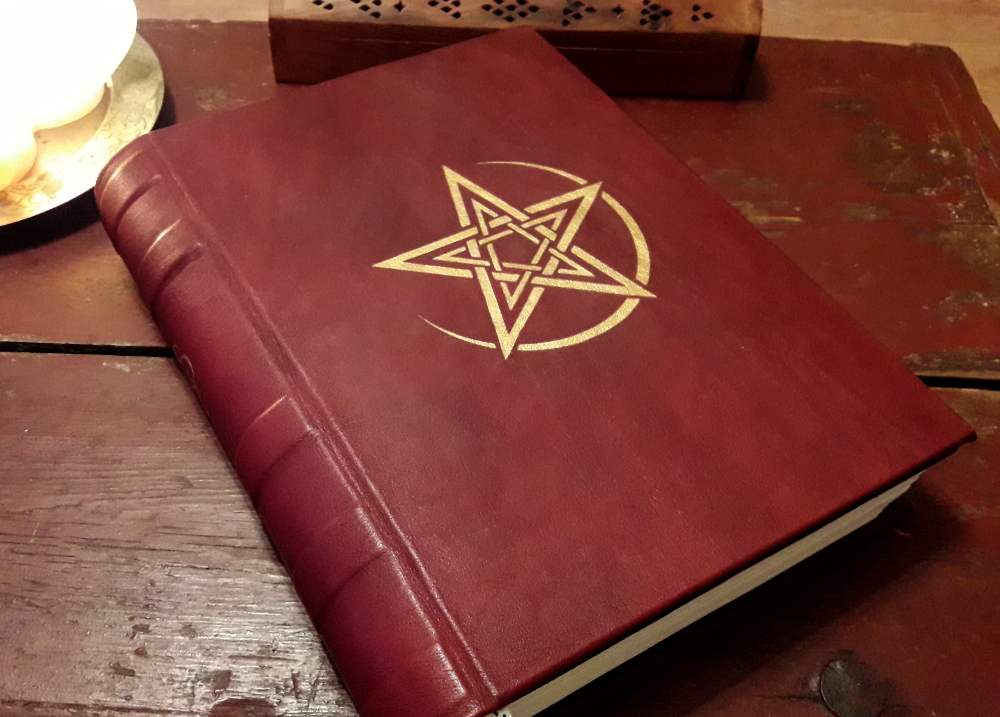
I have owned a large, hand made Book of Shadows for a few years now. It was a custom project hand made by a dear friend of mine, a monster of a book with 600+ pages. Basically it was a dream of mine come true to own such a tome. My intention from the beginning has been to fill it with information and to make it a collection of knowledge on my Wiccan path. 

My big, leather-bound Book of Shadows. So many pages to fill.

I have many different books and old Book of Shadows that I do use. But they are more like journals where I have collected my thoughts and different snippets of information from different sources. The intention of this book has therefore been to not just gather information, but to do so in a thought out way, preferably with a lot of pictures and drawings. This has meant that I have been very restrictive with what and how I write anything in my tome.

The big Book of Shadows-project, however, is now officially in the making. I have planned and made mock layouts for it for a while, and the thought process has taken its time. But I have finally begun to fill the pages with information. It is going to be a slow process, and it is ongoing. One does not simply fill 600+ pages in a few days.

Moon phases and how to utilize them for magical or other such workings.

The pages I have now been working on contain the moon phases, information on the moon, different moon deities, the Triple Goddess, and other moon related aspects of the Craft, such as chants and moon rituals.

The moon phases. I drew and painted this on a separate piece of paper and inserted it in the BoS.

I find myself enjoying drawing the images and making small doodles. Pictures speak their own language, and relay their own messages. My aim now is to consequently work with the BoS from time to time to fill its pages. I also want to share my progress in the hopes that it might inspire others in their own magical endeavors.

Blessed be!
~Stella

Tuesday, 3 September 2019

Money Jar Spell

Autumn has begun and with it I sense magic in the air, a buzzling feeling of a new season. I have recently started studying again, which means I have rather less money to live on than when I worked as a teacher. Thus, in order to attract prosperity into my life I went looking for spells of that kind.

Now, as always, one should never expect to just have money fall into one's hands just because of a money spell. It could happen, yes, but if you do not work toward your goal, you will most likely not see the results. The money spell I am about to write down might work for you or it might not, and I am in no way responsible for the results you have with it (if you perform it, go gamble and loose all your money, realize that you are the one responsible for that loss).

That said, let's get down to business.

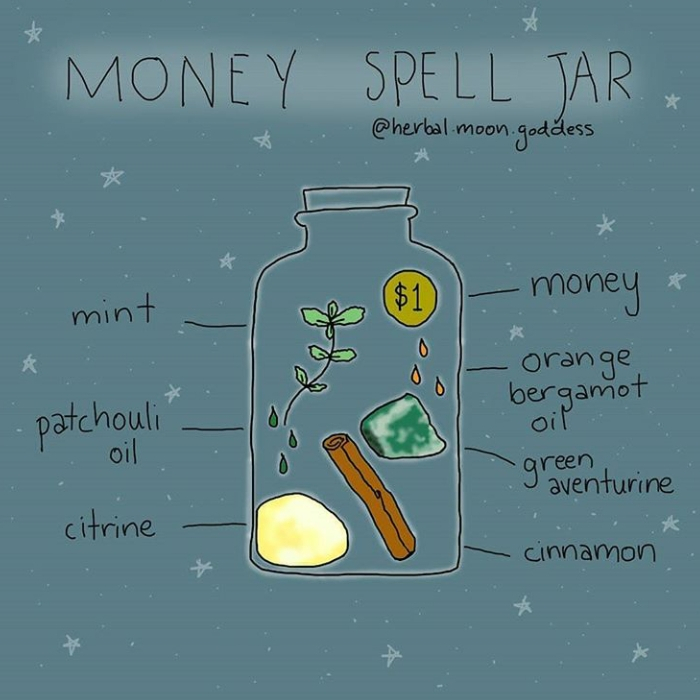
There are numerous money spells to be found in books and on the net. As I was casually browsing Instagram I came across this image that had been reposted by an other user:

Money spell jar by @herbal.moon.goddess on Instagram

It drew my attention and I felt inspired. So I copied it into my own spellbook, researched some correspondences and tweaked the spell to my liking. When doing magic, I feel it is important to listen to your intuition and do things that speak to you, that feel right. It is not about having to have the precise ingredients called for, or doing it at a time inconvenient to you. Choose ingredients for a spell that work for you and feel right for your working, and do the spell at a time that feels right. My instructions come with recommendation and suggestions, but you choose your own way of doing it.

The spell in it's original form calls for different ingredients with money correspondence to be put in a glass jar, then to be charged with your intentions and placed on your altar or carried with you to remind you of your goal.

Ingredients:

  • Container: a glass jar is suggested, but you could also use a wooden box or small pouch, especially if you will carry it around with you.
  • Representation of money: Like attracts like. You could use coins or bills to represent money, but if this is not possible, write a money symbol on a piece of paper and use that.
  • Herbs: There are numerous hers that can be used. Mint has long been associated with wealth and prosperity. Others could be (but are not limited to) cinnamon, allspice, cloves, chamomile, jasmine, nutmeg and vervain.
  • Essentioal oils: Patchouli and orange bergamot are the original suggestions, with options for chamomile, mint, cinnamon and basil
  • Crystals: Citrine, green aventurine, moss agate, tourmaline.
These are mere suggestions. Research books or the web to find other ingredients with correspondences to money. It you do not have a certain ingredient readily available, consider if it is strictly necessary for you to go out and buy it. In my mind, the point of a money and prosperity spell is not to spend money in order to work it, but to work with what you have to achieve your goals. It is not only about making money, but about saving it as well. With that said, here are some other things you might think of when working your money jar spell:

  • The colors green and gold (orange for success) are often used in money spells (that is the reason for choosing eg. citrine och green aventurine). Green is a color of growth while gold quite literally suggests wealth. Orange is a color for success. You could incorporate these colors by burning a candle of that color during the spell, and then again if you renew the spell or meditate on it. 
  • Moon phase: spells to draw money and prosperity toward you should ideally be performed during a waxing moon. If you have to do the spell during a waning moon, you might instead opt to let go of ill spending habits. 
  • Day of the week: Thursday is the day ruled by Jupiter and thus represents money and prosperity. You might opt to perform your spell on a Thursday of the waxing moon. 
There are several other correspondences you could incorporate, but I will repeat what I said earlier: Magic should be intuitive. If you hesitate because you fear you do not have the right ingredients, or might perform the ritual on the wrong day, then that doubt will influence your work. Correspondences are meant to help you bring power to your work easier. The more connections you feel that your spell has to the goal you are working toward, the easier it will be for you to perform your spell. So choose what you feel works for you and let's do some magic!

I copied the spell into my spell book, wrote down some additional information about different correspondences.
The chant I used popped into my mind during the spellcasting.

Like I said I tweaked the spell to suit my needs and chose ingredients based on what I had and what felt right. I ended up using an old glass jar (found at a flea market last year), a citrine and green agate, some pine nuts (because in the moment I opened my pantry my eyes fell on them and I thought "Yes! Those are the ones I will use") and some dried blackcurrant berries that I harvested and dried myself last year. I also included a gold colored coin, lit some patchouli and amber incense (I had mint oil in a diffuser in the room just before the ritual) and burned a green candle.

Once you have your ingredients, cleanse them in any way you wish (I used white sage), and create your sacred space. You do not need to do ritual if you do not want to, but I like to do it. I also like having a circle in place to store all power and not let other things that I have not invited in to influence my work. This is my basic ritual plan for spellwork, bare bones:

  1. Cleanse the ritual space, tools and yourself
  2. Ground and center
  3. Begin the ritual by casting a circle
  4. Call the quarters and deity 
  5. Preform the spell: Add the ingredients to the jar, stating with each ingredient your goal
  6. Raise energy for your spell. I did this by chanting:
Money and prosperity,
will be bountiful to me.

And once I had raised the energy and charged it into the jar I closed the top saying:

As I will, so mote it be!

     7. Thank deity and release the quarters
     8. Release the circle and extinguish any candles

You are now done. I allowed my green candle to burn  until I went to bed, and I will keep burning it and recharging the jar on Thursdays, renewing my consciousness about my goal.

Good luck in your spellwork!

Blessed be!

~Stella

Sunday, 27 May 2018

Review: Witch Casket February box

I finally have time to review the February box from Witch Casket. For those who do not know Witch Casket is a "vegan friendly, magickal witchy subscription box," according to their homepage. They are a mother-daughter company and make themed monthly subscription boxes. The February box is the second one I ordered, and this post will be my review of the box. So to start off, here is the list of contents:

The list of contents included in the box.

The theme of the February box is self love. This shows throughout most of the content, packaged in black and purple. In all I really like how nicely everything is packaged and how the color theme runs throughout the whole box. This creates a feeling that everything is well thought through. I will not comment on every product, but here are my thoughts on some of them. I will start with my least favorite things and move up from there.

Both boxes I have received so far have contained what I would describe as lifestyle, fashion or statement products, that do not directly have a magical application. Last time there was a badge and a hat. This time we get a keyring with the text "good witch", a badge with "mirror mirror" on it and a relaxation/meditation eye mask. These are the products I have spent most time pondering on what their function is in the box.

Don't get me wrong, these are really nice products, and things I can make use of. I love badges, for example, but I fail to see what this "mirror mirror" badge has to do with the box itself. Maybe I just feel that it could have said something relating more to the theme of the box, like "love yourself". The keyring has come in handy since I have been needing a new one.

The meditation mask with the text "Let me be, I'm meditating" is nice and edgy and it fits nicely. My biggest problem with it is that it is made out of cheap polyester (plastic), with no information about the material or how to care for it. I would appreciate it a hundred times more if it were made from natural fibers which would have made it more environmentally friendly. The thought behind the eye mask is nice and I will be using it on long trips.

Here are the contents of the February box.

The self-love bath/shower potion has been really nice. It is scented with a lavender perfume. The pentacle necklace from Curiology has to be one of the most unique pentacles I have ever seen. It is made from this holographic acrylic which makes it look pink, purple, green and some other colors at the same time. Not maybe what I would wear normally, but I am sure I will have a chance to include it with some outfit. To me it feels more like a fashion statement than religious jewelry.

The Blue Lady loose leaf tea was an interesting blend of black tea and maybe citrus? I don't normally like teas with lemon in them, so this is not my favourite tea. However, that is not my problem with it. My problem is that I would like to see the list on ingredients, which is something I could not find anywhere in the box. Especially for people with allergies or people on certain medication it is vital to know the ingredients of the tea they drink. Some herbs can counteract certain medicines and some ingredients might cause allergic reactions. I also like to know what is in the tea I am drinking.

Now moving on to the items I loved:

The self-love ritual kit, the art by TeaCakeArt, the candle snuffer and the affirmation card deck. Sorry for the glare that blurred out the text on the cards.
The candle snuffer is a practical tool I have been missing for a long time. I have been wanting to thrift one for ages but just have not found one. So when I found this black candle snuffer in the box I was thrilled. What is more, it is small and compact which is good if I need to travel with it.

The affirmation card deck has come in handy many times. I like that the cards are printed on sturdy cardstock and that they come in their own little pouch.

The self-love ritual kit was also very nice. The smell of rose and lavender that I was met with as I opened the bag was very pleasant. I am not a huge fan of tea candles so I have used some pink tapered candles dressed in lavender essential oil for the ritual included in the kit. It is a handy little ritual for learning to meditate and become mindful of the positive aspects of ones life.

In all I am very happy with the February box. Here is a compilation of the best parts and some thing I am missing or feeling thoughtful about:

+ I absolutely love the color theme and how it goes hand in hand with the content of the box. Most content seems to have a connection with the theme and the "side" products tie in with the themed products. The theme works and is well built.

- I would like to see some more background information for some products (and some ingredient lists for the tea). For beginning witches, especially, getting more instructions and information on how to use products and the symbology behind items, colors and herbs would be really helpful.

+ On that note I will continue by saying that the small information cards that do come along with some of the items are really nice and useful. They are a good introduction and I wish they came with more of the items. I have started collecting mine in the book that came with the January box.

-/+ I feel there is too much plastic in the box. I would feel better about the contents if they were packaged in paper as I am trying to reduce the amount of plastic I use. However, the box itself, as well as the small plastic bags can be reused. The bag for the tea and ritual kit are resealable, and what is even better is that they can be opened without tearing the top section off. So a big plus for that.

+ Even though I am not a fan of polyester, I do like the small organza bags that come with the badge and the keyring. These can easily be used to hold charms, gems or other things. I wish that the gemstone and the items from Curiology would also come packaged in small fabric bags instead of in plastic.

So that is it for the February box. All of the items have seen some use and will continue to do so. And I will continue ordering the box for as long as I can. It is not a hugely expensive subscription box, but I do not make a lot, so I had a break in ordering this item during March and April. The next box I review will be the May box, which just arrived.

If you have any questions or thoughts you can leave them in a comment below. I am not sponsored by Witch Casket. The opinions expressed are entirely my own. I pay for the box with my own hard-earned money, and the only contact I have had with the company is when I e-mailed them to change my address.

Have a blessed magical day!
~Stella